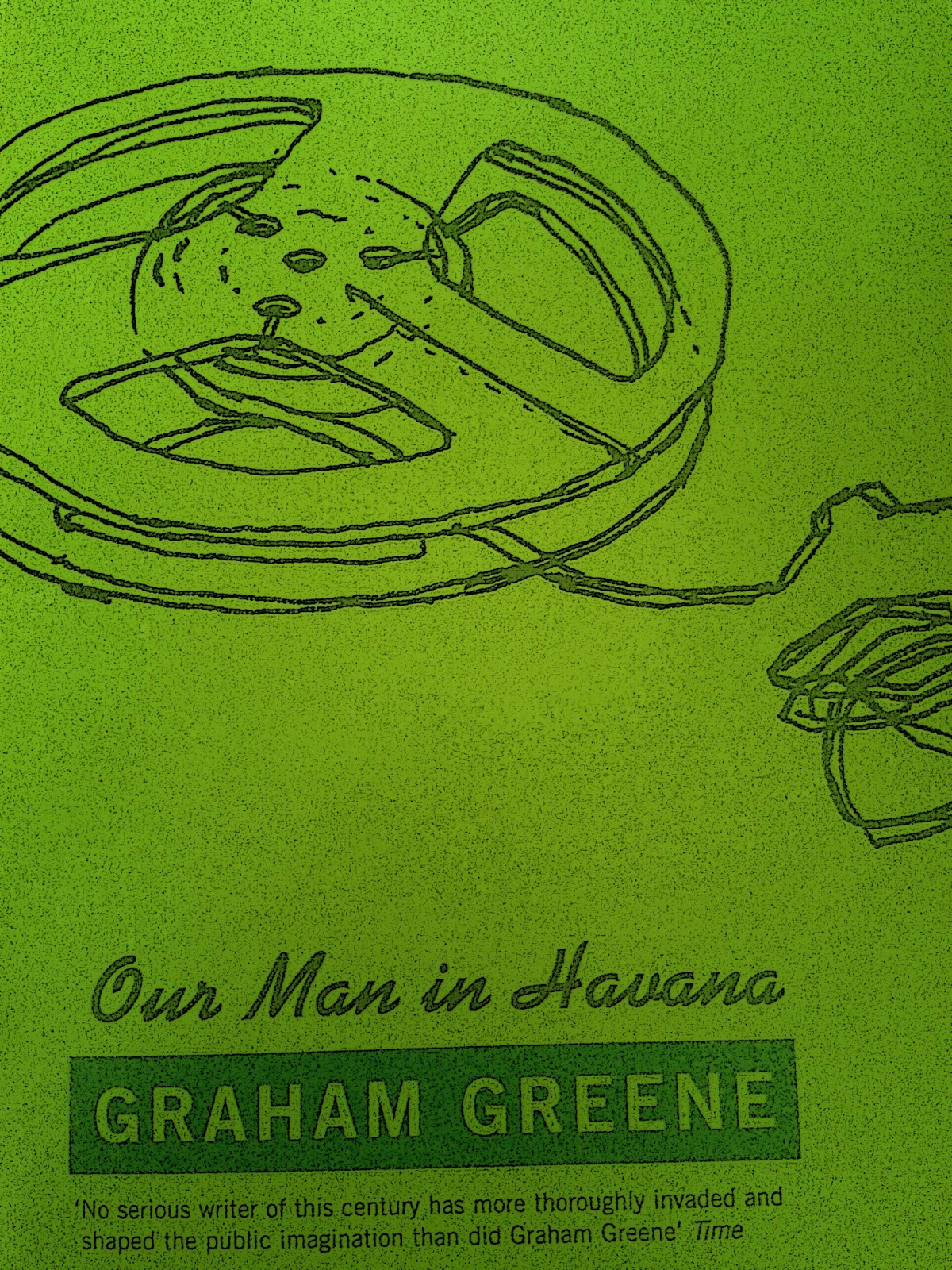
Set in the context of the cold war, first published in 1958,
Our Man in Havana, pokes fun at the world of espionage and in particular the British MI6. British expat vacuum cleaner salesman, James Wormald is reluctantly recruited to act as an informant for the British secret service. Wormald is not keen on the work and does not see how he is in a good position to be able to provide any secret information. He is tempted by the money offered and therefore concocts a scheme to invent information and send these fabricated reports back to Britain.
The premise seems almost unbelievable, could the world of spies really be so comical? Could government agencies really be so credulous?
Brutality in Cuba
Despite the comedy, the story is set in Cuba where real hardship was felt under the Batista regime. A disturbing exchange between the protagonist, and the police Captain Segura gives a glimpse of the brutality:
"Did you torture him?"
Captain Segura laughed. "No. He doesn't belong to the torturable class."
"I didn't know there were class-distinctions in torture."
"Dear Mr Wormald, surely you realise there are people who expect to be tortured and others who would be outraged by the idea. One never tortures except by a kind of mutual agreement."
In answer to who is torturable...
"The poor in my own country, in any Latin American country. The poor of central Europe and the Orient. Of course in your welfare states you have no poor, so you are untorturable. In Cuba the police can deal as harshly as they like with émigrés from Latin America and the Baltic States, but not with visitors from your country or Scandinavia. It is an instinctive matter on both sides. Catholics are more torturable than Protestants, just as they are more criminal..."
"One reason why the West hates the great Communist states is that they don't recognise class-distinctions. Sometimes they torture the wrong people. So too of course did Hitler and shocked the world. Nobody cares what goes on in our prisons, or the prisons of Lisbon or Caracas, but Hitler was too promiscuous."
Talking of one of Wormald's 'real' agents and shop salesman, Lopez...
"Be careful, Mr Wormald. He is one of the torturable." They both laughed, drinking daiquiris. It is easy to laugh at the idea of torture on a sunny day. "I must be going, Mr Wormald."
"I suppose the cells are full of my spies."
"We can always make room for another by having a few executions."
The book is published before the Cuban missile crisis but appears to predict the kind of furore and worries to come.
Catholicism
Another prevailing theme in the book is religion:
"Unlike Wormald, who believed in nothing. Milly was a Catholic: he had been made to promise her mother that before they married. Now her mother, he supposed, was of no faith at all, but she had left a Catholic on his hands."
Wormald's daughter, Milly, appears to be strict in her Catholicism at times but slips at others:
"[Wormald] believed that in the rich families the custom of keeping a duenna [an older woman acting as a governess and companion in charge of girls, a chaperone] lingered still, and sometimes it seemed to him that Milly too carried a duenna about with her, invisible to all eyes but her own. In church... the duenna was always seated by her side, to observe that her back was straight, her face covered at the suitable moment... "
Wormald mentions that it took him some time to realise that the duenna was not always at Milly's side. A milder example of this can be seen when Milly drops her veil of morality when she is excited at the thought of going to a nightclub for her birthday celebration.
More shockingly, Milly's lack of duenna is brought abruptly to Wormald's attention when Milly was 13 and she set a boy at her school on fire.
"Milly's only defence of her conduct had been that Earl [the boy she set on fire] was a Protestant and if there was going to be a persecution Catholics could always beat Protestants at that game."
...
Of course he [Wormald] spoke to Milly and her explanation had the virtue of simplicity.
"Why did you set fire to Earl?"
"I was tempted by the devil", she said.
"Milly, please be sensible."
"Saints have been tempted by the devil."
"You are not a saint."
"Exactly. That's why I fell."
Milly has a seemingly child-like approach to her faith. As shown in the way she uses her novenas [institutional act of religious pious devotion in the Roman Catholic Church, often consisting of private or public prayers repeated for nine successive days in belief of obtaining special intercessory graces] to ask for things she wants - like a horse. She has a child-like belief that it will all work.
Perhaps mirroring the way in which the British service seem to blindly believe Wormald's faked reports. Similarly, as Wormald's forgeries are discovered by the British, so too does Milly appear more 'grown up' in her faith. The duenna disappears as she has to sell her horse and go home to Britain.

 Death and the Alma Mater