Showing posts with label Book Reviews. Show all posts

Thursday, 11 April 2013

The Rising of the Moon - Gladys Mitchell

I began to be assailed by doubts... we had no proof that [they]intended to kill us. I was still in a state of suspended panic, but the fairy-gold logic of childhood was reasserting itself, with ultimate hope of victory, in my mind.
The Rising of the Moon has become one of my favourite Mrs. Bradley novels. I had the added novelty of reading this over the Easter period, when the series of murders begins! The story is written as a first person narrative of Master Simon Innes. Mrs Bradley does not enter the story until part way through, which means that a lot of the detective work is carried out by Simon and Keith Innes (13 and 11 years old respectively), brothers who find themselves involved in a mysterious case of serial murders in their small village. The first murder takes place at the Circus, much to the dismay of the boys:

"Heared about the Ripper?" asked Fred. "There won't be any circus this afternoon."

Up to that time it was the most terrible news I had ever heard, for we were too young to have been told outright about the deaths of our parents. We had found that news out gradually, and by putting two and two together; but this was a bolt from the blue.


Saturday, 6 April 2013

The Pastor of Vejlbye - Steen Steensen Blicher

Illustration by Povl Christensen (1909 - 1977)
I wanted to read this short-story as part of my mission to read more early mystery literature. The Pastor of Vejlbye was published in 1829 and subtitled 'A Crime Story'. It is often referred to as one of the first mystery novels. 


I enjoyed the story and found myself wanting to intervene to help certain characters. It was a good quick read and worth the trouble to find the book. I did not find it easy to get hold of an English translation of this short-story; I got it as part of a collection of short-stories in the end. If you don't want to struggle to get a physical copy of the book you can find a pdf version here.

The author, Steen Steensen Blicher, was one of Denmark's great Golden Age poets and short-story writers; he was much influenced by Scottish and English literature but never visited these countries.

The story is written in the form of a diary in two parts. The first part of the story is provided by Erik Sørensen, district sheriff, and the second part provided by the pastor of AAlsøe.

It is based upon (although does not follow exactly) a real event in 1626 when pastor Søren Qvist of Vejlbye (near Grenå) was sentenced to death, for the murder of his coachman in 1607, based on circumstantial evidence.


Searching for a body in the pastor's garden (Christensen)
Following the pastor's execution one of his sons investigates further into the events leading to his conviction. This leads to a new trial in 1634 when it is discovered that a number of the witnesses had committed perjury; both were then sentenced to death.

Blicher's short-story deviates from the authentic account of the case. He changes characters and adds a number of twists, including an interesting psychological aspect in respect to Søren Qvist's personality and beliefs. I won't give away the twists or the ending in order to preserve the suspense. :)


Monday, 25 March 2013

The Woman in White continued...

Harper's Weekly, 31 December 1859, Vol.III, No.157, p.841.
Illustrations by John McLenan
Weekly Part 6.
The woman in white took me so long to read that I thought it deserved two posts (it's a substantial book). 


I really enjoyed the story. I thought that the story progression in the first epoch was rather slow so it took me a while to get into the book. It sets out lots of unanswered questions. You see the questions mounting and foresee the numerous permutations of possible distasters without clue to which one will really happen, and you start to think that you might not get any answers. However, in the second epoch there is a lot more action and the final epoch does satisfy your questions (whether the outcome is to your liking is another matter).


My favourite bit is Miss Halcombe’s diary. Marian is my favourite character in the book. She’s a wonderfully strong female character, especially for the period. Here are a few of my favourite lines relating to Marian:

The Woman in White - Wilkie Collins

Harper's Weekly, 26 November 1859, Vol.III, No.152, p.753.
Illustrations by John McLenan
Weekly Part 1.
"[The Woman in White is] often singled out as the foundation text of "sensation fiction" – a genre distinguished by its electrifying, suspenseful, and sometimes horrific plots, as well as its unsavoury themes of intrigue, jealousy, murder, adultery, and the like..." The Guardian
The Woman in White was first serialised in Charles Dickens' weekly literary magazine, All the Year Round, between 1859–1860. Therefore celebrating its 150th anniversary in 2009. The story was later published as a book in 1860, first in three books, and then in one volume. The three book divisions serve as chapters (or epochs) in the single book version.

The initial format of small weekly articles can be seen to result in a long book. It is also the reason for the multitude of 'cliff-hangers' dotted throughout the narrative (carefully positioned at the end of each weekly publication), which give rise to the reputation for suspense the novel has accrued. To experience it as it's first Victorian audience did, the story can be read in its original weekly parts thanks to the 150th anniversary project. The story was published simultaneously in New York in Harper's Weekly, you can see the accompanying illustrations by John McLenan on the project site too.

The story is told in an epistolary format with testaments given by various characters, letters and other relevant text is also shared. The character narratives are given in the following order:

Epoch 1

  • Walter Hartright - Drawing Master
  • Vincent Gilmore - Solicitor
  • Marian Halcombe - Sister to Laura Fairlie 

Epoch 2

  • Continued by Marian Halcombe (Postscript by Count Fosco - Uncle by marriage to Laura Fairlie - see full title below)
  • Eliza Michelson - Housekeeper at Blackwater Park
  • Hester Pinhorn - Cook in the service of Count Fosco
  • Alfred Goodricke - Doctor
  • Jane Gould - Assistant to Mr Goodricke
  • Walter Hartright 

Epoch 3

  • Continued by Walter Hartright 
  • Mrs Catherick
  • Walter Hartright
  • Isidor, Ottavio, Baldassare Fosco - Count of the Holy Roman Empire, Knight Grand Cross of the Order of the Brazen Crown, Perpetual Arch-Master of the Rosicrucian Masons of Mesopotamia; Attached (in Honorary Capacities) to Societies Musical, Societies Medical, Societies Philosophical, and Societies General Benevolent, throughout Europe; etc. etc. etc. 
  • Concluded by Walter Hartright 

Wednesday, 13 March 2013

Up at the Villa - Somerset Maugham

Vintage Classics: Up at the Villa
I had not read any other of Maugham's works before I decided to read Up at the Villa. I didn't even know what the story was really about. I had heard that it contained elements of crime and suspense but was not strictly a mystery novel.

The novella is gripping and, as it is an easy-read and quite short, I finished it quickly. It is definitely worth reading.

It follows a beautiful widow, Mary Panton, and her experiences staying in a sixteenth century villa in Florence. Mary's time of tranquil reflection and sight-seeing is brought to an end violently by a mistaken act of (com)passion. Suddenly, to avoid scandal, Mary is carrying out acts she thought she would never contemplate.


The main characters are:
  • Mary Panton ~ 30 year old widow recovering from her unhappy marriage
[Rowley to Mary] "You're a brown and gold girl, aren't you?" he said.
Her hair was of a dark rich gold, her large eyes deep brown, and her skin pale gold. It was her colouring which took away the coldness which her regular features may have given her face and gave her a warmth and a richness which were infinitely alluring.
"I think you're the most beautiful woman I've ever seen."
  • Sir Edgar Swift ~ Mary's admirer, friend of her father's, and important Indian Government Official
[Edgar] had had a distinguished career. He had been for five years Governor of the North West Provinces and during a period of great unrest had conducted himself with conspicuous ability. He had finished the term with the reputation of being the most capable man in India.
  • Rowley Flint ~ lovable rogue
It was true that Rowley was not much to look at... He had not a single feature that you would call good... He was in short a young man with a shocking reputation which he thoroughly deserved.
 ...he's not the sort of feller... that a decent woman ought to be asked to sit in the same room with.
  • The Princess San Ferdinando ~ an elderly American woman who had married a Roman Prince and had two grown-up children in the Italian army
She had little money, but a caustic tongue and a great good nature... she knew everybody she wished to know and everybody was pleased to know her.
  • Karl Richter ~ Austrian art student residing in Italy after he escaped from a concentration camp
His suit was shabby, his shoes patched and his shirt, open at the neck, frayed... By the light of the tall candles on the table his eyes were dark and cavernous. He had a strange head with... high cheek bones, hollow cheeks, a pallid skin and a look of strain which was somewhat moving. It occurred to Mary that in costume, dressed, say, like one of those young princes in a picture by Bronzino at the Uffizi, he would have been very nearly beautiful.
 My favourite lines include:

Rawley on risk

"My dear, I'd have done it for any pal. I'm not quite sure if I wouldn't have done it for a total stranger. You know, I like risk. I'm not really a law-abiding person and I got a great thrill out if it. Once at Monte Carlo I had a thousand pounds on the turn of a card, that was a thrill too; but nothing to this"
"Don't be afraid. The devil's a sportsman and he looks after his own."

Mary accepting reality
And now she realised that there was something particularly shocking [in what had been done]. She still didn't know what else could have been done to avoid a fearful scandal and Heaven only knew what difficulties with the police. But it was so fantastic that anything like that should happen to people like her that it didn't seem to belong in real life; it was the kind of thing that happened to one in a nightmare.

 Mary's lawyer on marriage
"But don't marry for love next time; it's a mistake; marry for position and companionship."

Monday, 4 March 2013

Watson's Choice - Gladys Mitchell

Even though I only recently finished reading the Sherlock Holmes books at the end of last year, I still found it hard to identify all of the stories or characters referred to in Watson's Choice.

 Some of the stories I definitely remembered:
  • The Five Orange Pips
  • The Hound of the Baskervilles  (who couldn't?) 
  • The Adventure of the Speckled Band
  • The Silver Blaze (although I would not have realised the curry reference!)
  • The Adventure of the Blue Carbuncle
I did not remember the Mrs Farintosh reference. I will have to go back to the canon to check up on that.

I thought this book was wonderful and crammed with plenty of winks towards Sherlock Holmes. At first you expect a typical 'whodunnit' as a Sherlock Holmes themed dinner party is arranged. You eagerly await the moment one of the guests is found murdered... and then it doesn't happen. You get a completely different kind of murder mystery instead. Definitely keeps you guessing.

The part where Sir Bohun Chantrey admits that he was to arrange for a gaggle of geese to be let loose amongst his guests as a reference to the Aventure of the Blue Carbuncle actually made me think of the Series 4 Uskerty episode of Cabin Pressure. A series about a ramshackle crew of a small charter air line (or 'air dot' - you cannot put one plane in a line). Quoted from Cabin Pressure Live Journal. As background, Douglas has just told Arthur that Martin is 'the best at being made fun of' because he always goes that extra mile to provide material for you to make fun of. Also, they are at a small airfield where the hyperactive airport manager has been showing them all of the new equipment he has got. It's too complicated to explain the sheep...

My favourite section of the episode:

(Martin bursts through the door of the bar as Carolyn hurries away.)
ARTHUR: Hey, Skip!
MARTIN (urgently): Douglas, quick. I need your help.
DOUGLAS: Martin ... Good Lord, you’re soaking wet.
MARTIN: Yes, well, it’s raining outside. Look ...
DOUGLAS: What happened to your uniform?
MARTIN: I tore it falling out of a tree ...
DOUGLAS: Yes, but what’s that all over it?
MARTIN: Oh, er, goose droppings, but ...
DOUGLAS: Is your hand okay?
MARTIN (increasingly rapidly): No, a bee stung me ...
DOUGLAS: What are you carrying?
MARTIN (frantically): What does it look like?! A stuffed sheep!
DOUGLAS: You see, Arthur? The master.
MARTIN: Douglas, listen. There’s a truck full of geese outside and one of them ate my Dad’s ring and I don’t know which one and I know there’s nothing you can do but is there anything you can do?
DOUGLAS: Gosh. Well, it’s a-a bit of a tall order, Martin, even for me.
MARTIN (more quietly): You can’t do anything?
DOUGLAS: I didn’t say that. Gerry.
MARTIN: Douglas ...
DOUGLAS: This is Martin. Martin is a man who would like to discover which of a truckload of geese has swallowed a valuable ring. Martin, this is Gerry. Gerry is a man who wishes he could get more use out of his metal-detecting gate. Perhaps you two could have a profitable discussion.
GERRY: Oh, grand!
CAROLYN (urgently as she hurries over): Come on, come on. Where are you all? Twelve minutes.
MARTIN: Er, yes, Carolyn. But, er, b-before that, though, I-I just want to very quickly X-ray all the geese.
CAROLYN: You what?! No, I’m sorry, Martin, I’m very sorry, but there is no time! Now come on!
MARTIN (firmly): No. I’m sorry, Carolyn. I carried the sheep for you. I climbed the tree. I rode the back of the truck. But now I have to X-ray these geese.
DOUGLAS: Always the extra mile. 


Whilst trying to find the transcript I found this on John Finnemore's blog; it seems others had noticed the reference too. 

Wednesday, 20 February 2013

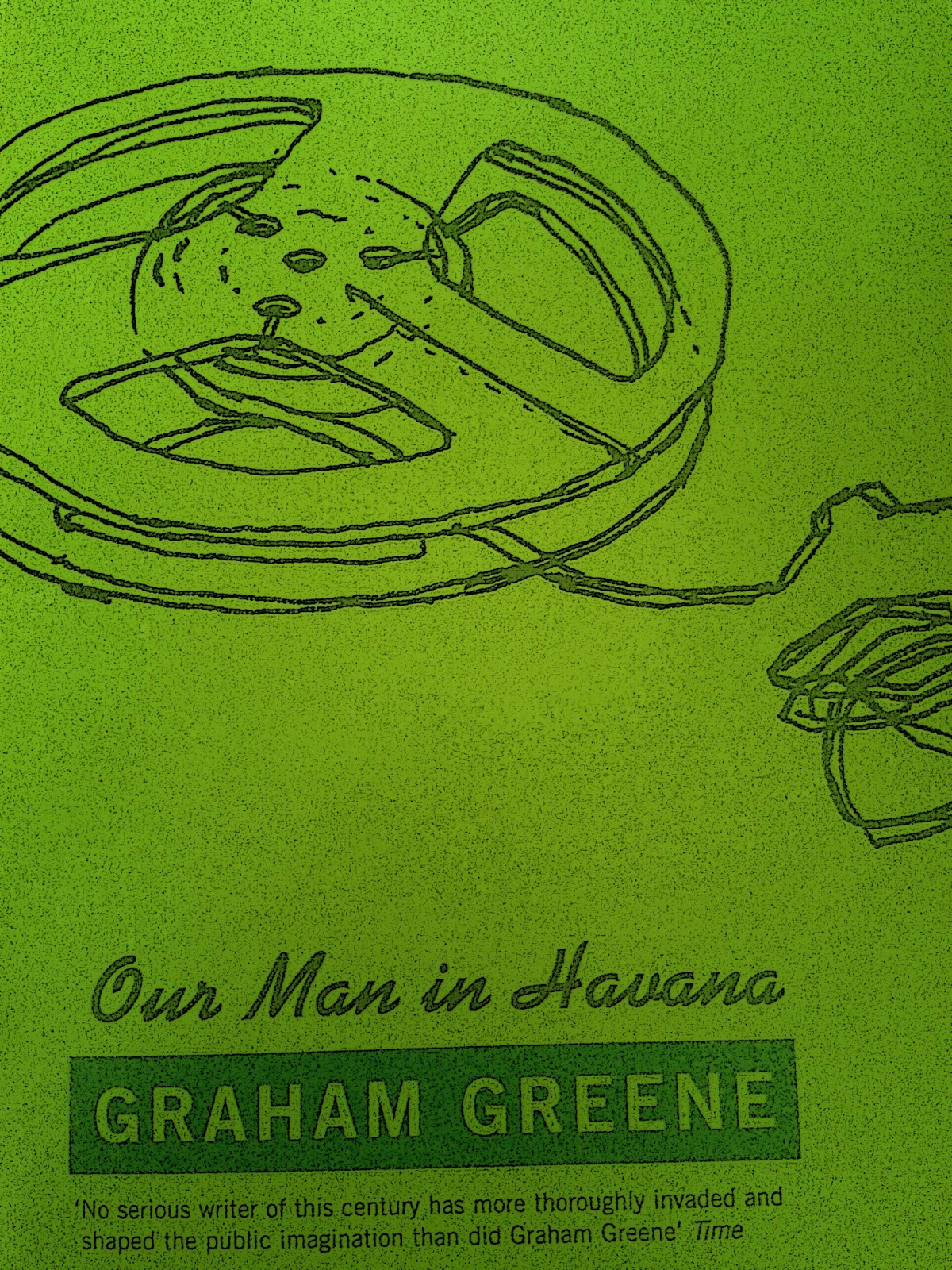
Our Man in Havana - Graham Greene

Set in the context of the cold war, first published in 1958, Our Man in Havana, pokes fun at the world of espionage and in particular the British MI6. British expat vacuum cleaner salesman, James Wormald is reluctantly recruited to act as an informant for the British secret service. Wormald is not keen on the work and does not see how he is in a good position to be able to provide any secret information. He is tempted by the money offered and therefore concocts a scheme to invent information and send these fabricated reports back to Britain.

The premise seems almost unbelievable, could the world of spies really be so comical? Could government agencies really be so credulous?

Brutality in Cuba

Despite the comedy, the story is set in Cuba where real hardship was felt under the Batista regime. A disturbing exchange between the protagonist, and the police Captain Segura gives a glimpse of the brutality:

"Did you torture him?"

Captain Segura laughed. "No. He doesn't belong to the torturable class."

"I didn't know there were class-distinctions in torture."

"Dear Mr Wormald, surely you realise there are people who expect to be tortured and others who would be outraged by the idea. One never tortures except by a kind of mutual agreement."

In answer to who is torturable...

"The poor in my own country, in any Latin American country. The poor of central Europe and the Orient. Of course in your welfare states you have no poor, so you are untorturable. In Cuba the police can deal as harshly as they like with émigrés from Latin America and the Baltic States, but not with visitors from your country or Scandinavia. It is an instinctive matter on both sides. Catholics are more torturable than Protestants, just as they are more criminal..."

"One reason why the West hates the great Communist states is that they don't recognise class-distinctions. Sometimes they torture the wrong people. So too of course did Hitler and shocked the world. Nobody cares what goes on in our prisons, or the prisons of Lisbon or Caracas, but Hitler was too promiscuous."
Talking of one of Wormald's 'real' agents and shop salesman, Lopez...

"Be careful, Mr Wormald. He is one of the torturable." They both laughed, drinking daiquiris. It is easy to laugh at the idea of torture on a sunny day. "I must be going, Mr Wormald."

"I suppose the cells are full of my spies."

"We can always make room for another by having a few executions."

The book is published before the Cuban missile crisis but appears to predict the kind of furore and worries to come.

Catholicism

 Another prevailing theme in the book is religion:

"Unlike Wormald, who believed in nothing. Milly was a Catholic: he had been made to promise her mother that before they married. Now her mother, he supposed, was of no faith at all, but she had left a Catholic on his hands."

Wormald's daughter, Milly, appears to be strict in her Catholicism at times but slips at others:

"[Wormald] believed that in the rich families the custom of keeping a duenna [an older woman acting as a governess and companion in charge of girls, a chaperone] lingered still, and sometimes it seemed to him that Milly too carried a duenna about with her, invisible to all eyes but her own. In church... the duenna was always seated by her side, to observe that her back was straight, her face covered at the suitable moment... "
 Wormald mentions that it took him some time to realise that the duenna was not always at Milly's side. A milder example of this can be seen when Milly drops her veil of morality when she is excited at the thought of going to a nightclub for her birthday celebration.

More shockingly, Milly's lack of duenna is brought abruptly to Wormald's attention when Milly was 13 and she set a boy at her school on fire.

"Milly's only defence of her conduct had been that Earl [the boy she set on fire] was a Protestant and if there was going to be a persecution Catholics could always beat Protestants at that game."
 ...

Of course he [Wormald] spoke to Milly and her explanation had the virtue of simplicity.
"Why did you set fire to Earl?"
"I was tempted by the devil", she said.
"Milly, please be sensible."
"Saints have been tempted by the devil."
"You are not a saint."
"Exactly. That's why I fell."
Milly has a seemingly child-like approach to her faith. As shown in the way she uses her novenas [institutional act of religious pious devotion in the Roman Catholic Church, often consisting of private or public prayers repeated for nine successive days in belief of obtaining special intercessory graces] to ask for things she wants - like a horse. She has a child-like belief that it will all work.

Perhaps mirroring the way in which the British service seem to blindly believe Wormald's faked reports. Similarly, as Wormald's forgeries are discovered by the British, so too does Milly appear more 'grown up' in her faith. The duenna disappears as she has to sell her horse and go home to Britain.

Thursday, 1 November 2012

Sherlock Holmes

Sherlock Holmes Stories (in 9 books: 4 novels and 5 collections)

I am part way through my mission to read all of the Sherlock Holmes stories. It is an exciting journey and I cannot believe that I left it so long before attempting this. I am somewhat of a fan of mystery novels. I have devoured a number of different types by different authors, but the later part of this year I have dedicated to consuming the Sherlock Holmes narrative.

I have just completed The Valley of Fear; I am reading them in the following order:
  • A Study in Scarlet
  • The Sign of Four
  • The Adventures of Sherlock Holmes
  • The Memoirs of Sherlock Holmes
  • The Hound of the Baskervilles
  • The Return of Sherlock Holmes
  • The Valley of Fear
  • The Case Book of Sherlock Holmes
  • His Last Bow
I was reading them in this order as it appeared to be roughly publication order (of the compilations not the short stories themselves). Although I am not sure if this is chronologically the best order to read them in. I got a bit confused in terms of when this was set when I read The Valley of Fear because I was led to believe that in "The Final Problem" in The Memoirs of Sherlock Holmes, that Holmes and Watson were talking about Moriarty for the first time. Watson appeared not to know about Moriarty and Holmes had to explain. However, Moriarty appears to be alive in The Valley of Fear so this must be set before "The Final Problem" and yet Watson appears to know all about Moriarty here! I can think only of two explanations:
1. Watson did know about Moriarty and had a lapse of memory during his encounter with Holmes as told in "The Final Problem".
2. The Valley of Fear was written up as a story by Watson after "The Final Problem" and Watson has provided information on Moriarty from Holmes that was supplied at a later date to make the story more detailed retrospectively.

Despite my confusion with the jumping backwards and forwards in time, I have really enjoyed the Sherlock Holmes books and think they could be entertaining read in any order.

The Valley of Fear reminded me of A Study in Scarlet in the way it is broken into two parts. The first part is the present day story of how Sherlock Holmes explains the mysterious events and the second part is the background story which led to the mysterious event occurring. Finally these are brought together and wrapped up. I love the way this is done. I found myself unable to put the book down with an irrepressible eagerness to discover the underlying motives of the main characters. I have seen other people criticise A Study in Scarlet saying that it was not as good as some of the other writings as Conan Doyle was still an inexperienced writer. I did not find this to be the case at all. I will admit however, that at first I was confused and a bit disappointed because it seems like Sherlock Holmes discovers 'whodunnit' without providing you with enough explanation or clues to be able to piece together how he knew. It then appeared to just delve straight into a completely different story. Thankfully I was patient enough to get into the 'other story' and realise that the two were in fact related. I am glad that I stuck with it because the results were fantastic. The break in The Valley of Fear was not so disjointed so it was obviously you were now reading the background story. ;)

At present I cannot pick a favourite. I shall wait until I have finished the collection and then pronounce. Two more to go. Perhaps finished by the end of the year? I have been side-tracked by P.D. James. :)

Before I forget, I recently found that apparently the "world's funniest joke" is suppose to be one involving Sherlock Holmes (according to Wikipedia):

Sherlock Holmes and Dr Watson were going camping. They pitched their tent under the stars and went to sleep. Sometime in the middle of the night Holmes woke Watson up and said: "Watson, look up at the stars, and tell me what you see." Watson replied: "I see millions and millions of stars." Holmes said: "And what do you deduce from that?" Watson replied: "Well, if there are millions of stars, and if even a few of those have planets, it’s quite likely there are some planets like Earth out there. And if there are a few planets like Earth out there, there might also be life." And Holmes said: "Watson, you idiot, it means that somebody stole our tent."