Wednesday, 6 March 2013

Libraries

From http://tigergrowl.wordpress.com
This week I have been working in York's central library, Explore York, because it is a wonderfully central location near to the Minster at the appropriately named Library Square, York. The building is lovely to look at, with a fine red brick frontage, beautiful windows, and sweeping staircases.

Today the library is closed. I am told this is to enable all library staff to take part in an important meeting to plan the future of the service. In the difficult economic times council's have to decide how to spend taxpayer money and libraries are not high on that list. York's libraries webpage says:
  
"...[as] a result of the Council's overall financial pressures... we are currently looking at the possibility of setting up the library service as a social enterprise. We believe this would better enable us to direct our resources into maintaining front line library services."


From www.yorkstories.co.uk
It will be interesting to see how this works. I hope it will be a successful way to help us retain our library service. Explore York is the main library in York and as a result it is very busy. It has a fairly modern library layout with the inclusion of a cafe and rather a lot of computers. There is also free wifi available. However, many local libraries are not so advanced with respect to IT provisions and have suffered falling visitor and borrower numbers. Books are also a lot cheaper and more widely available than they used to be, which has perhaps driven the fall in library users. Given this context it seems unsurprising that councils may look to cut back spending and provisions for library services. 

Having said this, I hope there can be a successful way to retain a library as a local meeting place, an area for study, learning and reflection. With the incorporation of new technology, the cafe culture, and additional learning services (for both children and adults), libraries may be able to survive.
From geograph.org.uk

 More immediately the closure has meant that today I am working from one of York University libraries. These are freely open to the public for reference use. I think this is a wonderful resource. Not as beautiful a building outside, but the resources and facilities inside are great. 

I had York down as my reserve place when I applied for university. I now get to experience what working in the library here would have been like. Thank you York! :)


Tuesday, 5 March 2013

When is a puzzle not a puzzle?

Tea Break

I shared the Christie article with my friends for fun, thinking that my voice and love of mysteries would be recognised in the opening sentence:
"Sometimes, I try to read novels in which solving a mystery is not the driving force propelling the reader forward. This can occasionally be OK – if there's enough relationship intrigue of the betrayal-and-adultery ilk – but generally I prefer novels that make me desperate to find out who did what and why."
However, being a philosopher, one read the article and decided that he did not agree with the argument presented. Apparently the writer has deployed the fallacy of the undistributed middle to conflate two distinct types of puzzles. To begin she appears to propose that puzzles are better than psychological insight, but then seems self-contradictory when she attempts to equate them in her other two paragraphs.

Monday, 4 March 2013

Mystery books in York

I love books and places that books are kept. As a result of this I love libraries. They are my favourite place to work. I like the peace and quite that they afford. I also like bookshops, second-hand bookshops in particular. I enjoy ferreting around a second-hand bookshop just in case they have a book I am after or even just an interesting book that I never even thought or known about before.

I have been looking for mystery books in York today. I found this useful website listing second-hand bookshops in York. I had a wonderful time rummaging amongst the shelves. I went into two bookshops: Lucius Books and Minster Gate Bookshop, both of which were delightful.

Today I bought Wilkie Collins, The Woman in White, and Graham Greene, Brighton Rock. They are on my list of books to read this year. The rest of the books on my list are harder to get as a number of them were first published in the early to mid-nineteenth century. They are not all still in print, so I am hoping to be able to do some fortuitous web searching for them. :)

Sometimes, I try to read novels in which solving a mystery is not the driving force propelling the reader forward


One, Two, Buckle My Shoe, Agatha Christie
Okay, I admit that I do tend towards agreeing with this statement. If there was a 0 - 5 scale where I had to rate how much 'I agreed', I'd probably be far more on the agreeing side. ;)


"Sometimes, I try to read novels in which solving a mystery is not the driving force propelling the reader forward. This can occasionally be OK – if there's enough relationship intrigue of the betrayal-and-adultery ilk – but generally I prefer novels that make me desperate to find out who did what and why."

As Sophie Hannah states in her Guardian author review, my love of mystery books probably does stem from Agatha Christie too. Her and Enid Blyton's Famous Five and Secret Seven.

Watson's Choice - Gladys Mitchell

Even though I only recently finished reading the Sherlock Holmes books at the end of last year, I still found it hard to identify all of the stories or characters referred to in Watson's Choice.

 Some of the stories I definitely remembered:
  • The Five Orange Pips
  • The Hound of the Baskervilles  (who couldn't?) 
  • The Adventure of the Speckled Band
  • The Silver Blaze (although I would not have realised the curry reference!)
  • The Adventure of the Blue Carbuncle
I did not remember the Mrs Farintosh reference. I will have to go back to the canon to check up on that.

I thought this book was wonderful and crammed with plenty of winks towards Sherlock Holmes. At first you expect a typical 'whodunnit' as a Sherlock Holmes themed dinner party is arranged. You eagerly await the moment one of the guests is found murdered... and then it doesn't happen. You get a completely different kind of murder mystery instead. Definitely keeps you guessing.

The part where Sir Bohun Chantrey admits that he was to arrange for a gaggle of geese to be let loose amongst his guests as a reference to the Aventure of the Blue Carbuncle actually made me think of the Series 4 Uskerty episode of Cabin Pressure. A series about a ramshackle crew of a small charter air line (or 'air dot' - you cannot put one plane in a line). Quoted from Cabin Pressure Live Journal. As background, Douglas has just told Arthur that Martin is 'the best at being made fun of' because he always goes that extra mile to provide material for you to make fun of. Also, they are at a small airfield where the hyperactive airport manager has been showing them all of the new equipment he has got. It's too complicated to explain the sheep...

My favourite section of the episode:

(Martin bursts through the door of the bar as Carolyn hurries away.)
ARTHUR: Hey, Skip!
MARTIN (urgently): Douglas, quick. I need your help.
DOUGLAS: Martin ... Good Lord, you’re soaking wet.
MARTIN: Yes, well, it’s raining outside. Look ...
DOUGLAS: What happened to your uniform?
MARTIN: I tore it falling out of a tree ...
DOUGLAS: Yes, but what’s that all over it?
MARTIN: Oh, er, goose droppings, but ...
DOUGLAS: Is your hand okay?
MARTIN (increasingly rapidly): No, a bee stung me ...
DOUGLAS: What are you carrying?
MARTIN (frantically): What does it look like?! A stuffed sheep!
DOUGLAS: You see, Arthur? The master.
MARTIN: Douglas, listen. There’s a truck full of geese outside and one of them ate my Dad’s ring and I don’t know which one and I know there’s nothing you can do but is there anything you can do?
DOUGLAS: Gosh. Well, it’s a-a bit of a tall order, Martin, even for me.
MARTIN (more quietly): You can’t do anything?
DOUGLAS: I didn’t say that. Gerry.
MARTIN: Douglas ...
DOUGLAS: This is Martin. Martin is a man who would like to discover which of a truckload of geese has swallowed a valuable ring. Martin, this is Gerry. Gerry is a man who wishes he could get more use out of his metal-detecting gate. Perhaps you two could have a profitable discussion.
GERRY: Oh, grand!
CAROLYN (urgently as she hurries over): Come on, come on. Where are you all? Twelve minutes.
MARTIN: Er, yes, Carolyn. But, er, b-before that, though, I-I just want to very quickly X-ray all the geese.
CAROLYN: You what?! No, I’m sorry, Martin, I’m very sorry, but there is no time! Now come on!
MARTIN (firmly): No. I’m sorry, Carolyn. I carried the sheep for you. I climbed the tree. I rode the back of the truck. But now I have to X-ray these geese.
DOUGLAS: Always the extra mile. 


Whilst trying to find the transcript I found this on John Finnemore's blog; it seems others had noticed the reference too. 

Wednesday, 20 February 2013

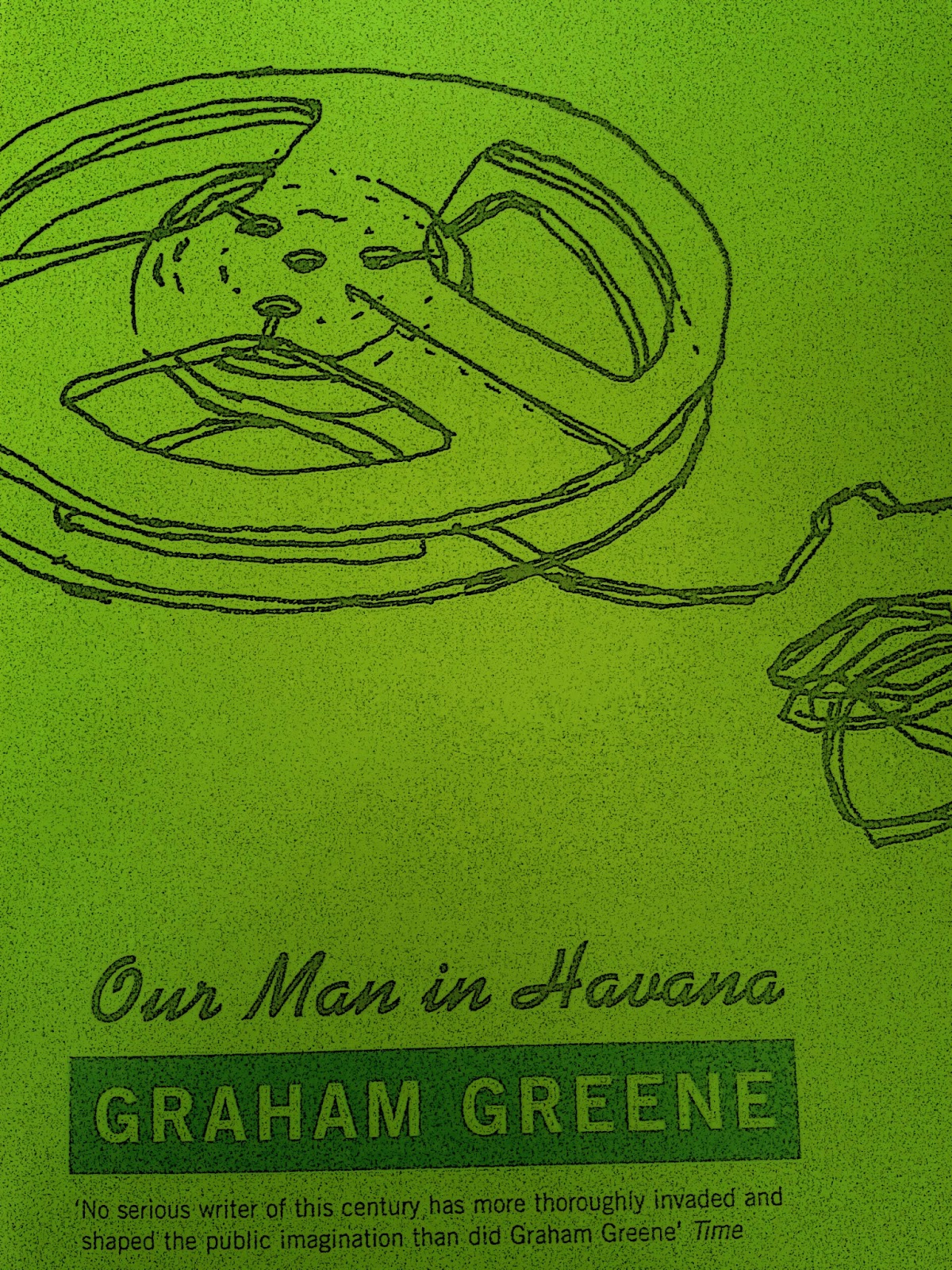
Our Man in Havana - Graham Greene

Set in the context of the cold war, first published in 1958, Our Man in Havana, pokes fun at the world of espionage and in particular the British MI6. British expat vacuum cleaner salesman, James Wormald is reluctantly recruited to act as an informant for the British secret service. Wormald is not keen on the work and does not see how he is in a good position to be able to provide any secret information. He is tempted by the money offered and therefore concocts a scheme to invent information and send these fabricated reports back to Britain.

The premise seems almost unbelievable, could the world of spies really be so comical? Could government agencies really be so credulous?

Brutality in Cuba

Despite the comedy, the story is set in Cuba where real hardship was felt under the Batista regime. A disturbing exchange between the protagonist, and the police Captain Segura gives a glimpse of the brutality:

"Did you torture him?"

Captain Segura laughed. "No. He doesn't belong to the torturable class."

"I didn't know there were class-distinctions in torture."

"Dear Mr Wormald, surely you realise there are people who expect to be tortured and others who would be outraged by the idea. One never tortures except by a kind of mutual agreement."

In answer to who is torturable...

"The poor in my own country, in any Latin American country. The poor of central Europe and the Orient. Of course in your welfare states you have no poor, so you are untorturable. In Cuba the police can deal as harshly as they like with émigrés from Latin America and the Baltic States, but not with visitors from your country or Scandinavia. It is an instinctive matter on both sides. Catholics are more torturable than Protestants, just as they are more criminal..."

"One reason why the West hates the great Communist states is that they don't recognise class-distinctions. Sometimes they torture the wrong people. So too of course did Hitler and shocked the world. Nobody cares what goes on in our prisons, or the prisons of Lisbon or Caracas, but Hitler was too promiscuous."
Talking of one of Wormald's 'real' agents and shop salesman, Lopez...

"Be careful, Mr Wormald. He is one of the torturable." They both laughed, drinking daiquiris. It is easy to laugh at the idea of torture on a sunny day. "I must be going, Mr Wormald."

"I suppose the cells are full of my spies."

"We can always make room for another by having a few executions."

The book is published before the Cuban missile crisis but appears to predict the kind of furore and worries to come.

Catholicism

 Another prevailing theme in the book is religion:

"Unlike Wormald, who believed in nothing. Milly was a Catholic: he had been made to promise her mother that before they married. Now her mother, he supposed, was of no faith at all, but she had left a Catholic on his hands."

Wormald's daughter, Milly, appears to be strict in her Catholicism at times but slips at others:

"[Wormald] believed that in the rich families the custom of keeping a duenna [an older woman acting as a governess and companion in charge of girls, a chaperone] lingered still, and sometimes it seemed to him that Milly too carried a duenna about with her, invisible to all eyes but her own. In church... the duenna was always seated by her side, to observe that her back was straight, her face covered at the suitable moment... "
 Wormald mentions that it took him some time to realise that the duenna was not always at Milly's side. A milder example of this can be seen when Milly drops her veil of morality when she is excited at the thought of going to a nightclub for her birthday celebration.

More shockingly, Milly's lack of duenna is brought abruptly to Wormald's attention when Milly was 13 and she set a boy at her school on fire.

"Milly's only defence of her conduct had been that Earl [the boy she set on fire] was a Protestant and if there was going to be a persecution Catholics could always beat Protestants at that game."
 ...

Of course he [Wormald] spoke to Milly and her explanation had the virtue of simplicity.
"Why did you set fire to Earl?"
"I was tempted by the devil", she said.
"Milly, please be sensible."
"Saints have been tempted by the devil."
"You are not a saint."
"Exactly. That's why I fell."
Milly has a seemingly child-like approach to her faith. As shown in the way she uses her novenas [institutional act of religious pious devotion in the Roman Catholic Church, often consisting of private or public prayers repeated for nine successive days in belief of obtaining special intercessory graces] to ask for things she wants - like a horse. She has a child-like belief that it will all work.

Perhaps mirroring the way in which the British service seem to blindly believe Wormald's faked reports. Similarly, as Wormald's forgeries are discovered by the British, so too does Milly appear more 'grown up' in her faith. The duenna disappears as she has to sell her horse and go home to Britain.

Thursday, 1 November 2012

Sherlock Holmes

Sherlock Holmes Stories (in 9 books: 4 novels and 5 collections)

I am part way through my mission to read all of the Sherlock Holmes stories. It is an exciting journey and I cannot believe that I left it so long before attempting this. I am somewhat of a fan of mystery novels. I have devoured a number of different types by different authors, but the later part of this year I have dedicated to consuming the Sherlock Holmes narrative.

I have just completed The Valley of Fear; I am reading them in the following order:
  • A Study in Scarlet
  • The Sign of Four
  • The Adventures of Sherlock Holmes
  • The Memoirs of Sherlock Holmes
  • The Hound of the Baskervilles
  • The Return of Sherlock Holmes
  • The Valley of Fear
  • The Case Book of Sherlock Holmes
  • His Last Bow
I was reading them in this order as it appeared to be roughly publication order (of the compilations not the short stories themselves). Although I am not sure if this is chronologically the best order to read them in. I got a bit confused in terms of when this was set when I read The Valley of Fear because I was led to believe that in "The Final Problem" in The Memoirs of Sherlock Holmes, that Holmes and Watson were talking about Moriarty for the first time. Watson appeared not to know about Moriarty and Holmes had to explain. However, Moriarty appears to be alive in The Valley of Fear so this must be set before "The Final Problem" and yet Watson appears to know all about Moriarty here! I can think only of two explanations:
1. Watson did know about Moriarty and had a lapse of memory during his encounter with Holmes as told in "The Final Problem".
2. The Valley of Fear was written up as a story by Watson after "The Final Problem" and Watson has provided information on Moriarty from Holmes that was supplied at a later date to make the story more detailed retrospectively.

Despite my confusion with the jumping backwards and forwards in time, I have really enjoyed the Sherlock Holmes books and think they could be entertaining read in any order.

The Valley of Fear reminded me of A Study in Scarlet in the way it is broken into two parts. The first part is the present day story of how Sherlock Holmes explains the mysterious events and the second part is the background story which led to the mysterious event occurring. Finally these are brought together and wrapped up. I love the way this is done. I found myself unable to put the book down with an irrepressible eagerness to discover the underlying motives of the main characters. I have seen other people criticise A Study in Scarlet saying that it was not as good as some of the other writings as Conan Doyle was still an inexperienced writer. I did not find this to be the case at all. I will admit however, that at first I was confused and a bit disappointed because it seems like Sherlock Holmes discovers 'whodunnit' without providing you with enough explanation or clues to be able to piece together how he knew. It then appeared to just delve straight into a completely different story. Thankfully I was patient enough to get into the 'other story' and realise that the two were in fact related. I am glad that I stuck with it because the results were fantastic. The break in The Valley of Fear was not so disjointed so it was obviously you were now reading the background story. ;)

At present I cannot pick a favourite. I shall wait until I have finished the collection and then pronounce. Two more to go. Perhaps finished by the end of the year? I have been side-tracked by P.D. James. :)

Before I forget, I recently found that apparently the "world's funniest joke" is suppose to be one involving Sherlock Holmes (according to Wikipedia):

Sherlock Holmes and Dr Watson were going camping. They pitched their tent under the stars and went to sleep. Sometime in the middle of the night Holmes woke Watson up and said: "Watson, look up at the stars, and tell me what you see." Watson replied: "I see millions and millions of stars." Holmes said: "And what do you deduce from that?" Watson replied: "Well, if there are millions of stars, and if even a few of those have planets, it’s quite likely there are some planets like Earth out there. And if there are a few planets like Earth out there, there might also be life." And Holmes said: "Watson, you idiot, it means that somebody stole our tent."